

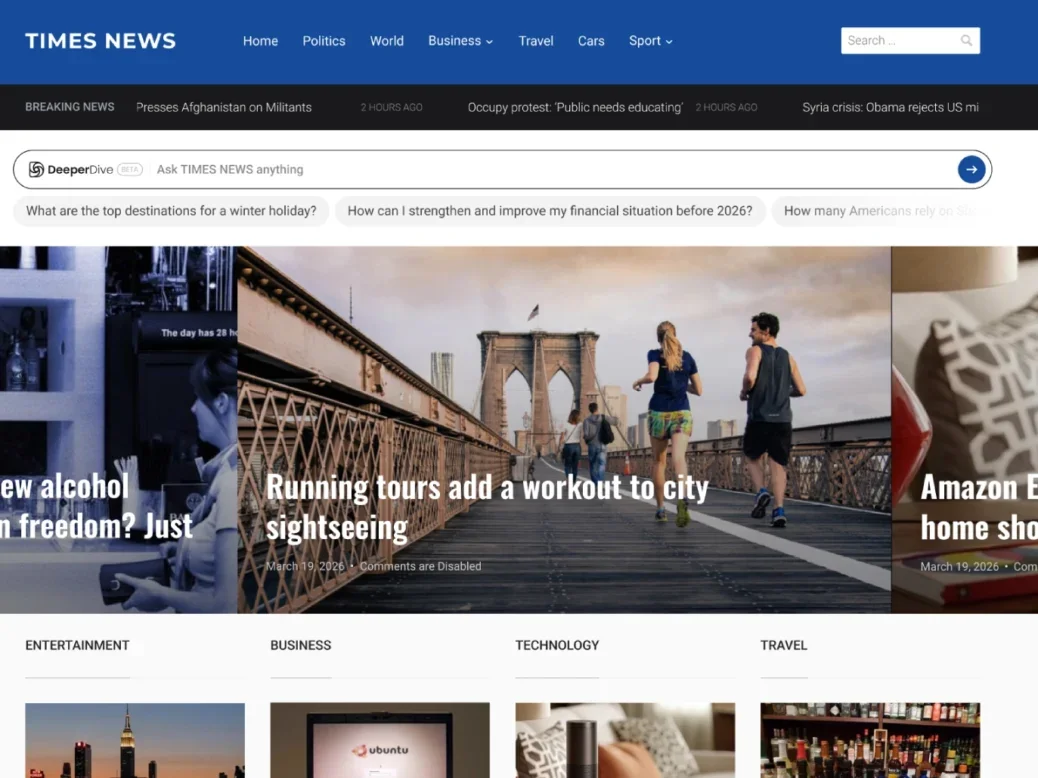
Taboola’s AI search engine is being used by up to one in six users on publisher websites that have rolled it out, the adtech company has said.
Adverts next to Deeper Dive answers are now providing higher conversion rates than traditional website ad slots, CEO Adam Singolda told Press Gazette.
Deeper Dive is an AI-powered search engine that can be added for free to publisher websites on any page, including the homepage or articles. Publishers receive a share of revenue from adverts placed at the top and bottom of the answers.
The format begins with a short chatbot-style answer before more context is provided via links to relevant further coverage on the publisher’s website or wider network. Publishers can also choose whether to plug in a third-party feed, such as police press releases, to add further relevant information. There is a text box at the end to ask a follow-up question if needed.
Reach (via sites like the Daily Star) and The Independent are among the dozens of publishers who have tried out Deeper Dive since its launch in September. Huffpost UK (run under licence by The Independent) is the newest launch, announced this week.
Deeper Dive has just expanded into six non-English languages (French, German, Hebrew, Japanese, Korean, and Spanish) and added publishers Ouest France, El Nacional in Spain, and Israeli news site Ynet.
Taboola said Deeper Dive is now being used by seven million people each month (meaning people who are actively typing in questions).

The most popular question categories within Deeper Dive include politics, sports, finance, entertainment and shopping. Taboola said around 50% of user questions relate to the last 24 hours of news, entertainment and sports.
Users that interact with the Deeper Dive interface are said to be 20% more likely to read another article.
‘It is unique to see such big adoption’
Taboola said publishers that have integrated Deeper Dive are seeing up to one in six visitors (or 17%) asking questions.
“I’ve been doing this for 15 years. I’ve seen one in 100. I’ve never seen one in six. I’ve never seen one in 50,” Singolda said of publisher engagement rates. “None of this makes sense. It’s so unique to see such big adoption. As publishers, we get excited if 1% of people click on an ad.”
Singolda, who founded Taboola in 2007, said Deeper Dive has proved notable within his career both for this “incredible” performance and for the interest it has received from senior publishing executives.
USA Today Co (formerly Gannett) chief executive Mike Reed told investors on 30 October that in the previous six weeks, users of the USA Today website had “asked more than three million questions with average daily activity well over 50,000 interactions.
“These early results show strong traction and highlight the meaningful opportunities to drive higher readership, deeper engagement and in turn, enhanced monetisation on our platform,” Reed said.
Singolda also said that Deeper Dive has become Taboola’s “number one converting interface” for adverts.
This means that compared to adverts elsewhere on a publisher website, at the bottom or the side of an article, in the middle of a page or on the homepage, Deeper Dive has the best conversion rate for advertisers, with users going on to make a purchase or fill in a form, for example, after clicking through. Singolda attributed this to the fact the people who use Deeper Dive are effectively a “super user” and said their “intent goes up so much”.
He said Deeper Dive is currently seeing “not insignificant revenue growth” and noted it is only six months in. He described it as a small but “growing fast” part of Taboola’s $2bn annual revenue.
Taboola’s main business is powering paid-for lists of suggested stories and adverts which appear on publisher websites.
Singolda said that when Deeper Dive first launched six months ago, “most people didn’t know what to do with it – so the first day, engagement was horrible”.
This was solved by adding personalised suggested questions in the text box that are influenced by users’ own browsing history, tracked anonymously via cookies on Taboola’s many client publisher websites.
He said this proved to be a “significant portion of the habit creation. If you just put a chat bar… I’m guessing less than 1% of people use it… If you can propose a question based on what I’m actually reading from the entire internet, you can teach me the habit. You can bring me in.”
Singolda described this access to browser data as “one of the biggest advantages we have over ChatGPT and Perplexity”.
Next phase for Deeper Dive could be agentic AI
Singolda suggested Deeper Dive will evolve towards more agentic AI behaviour in the future.
For example, he said, today a user might ask a publisher’s answer engine to share travel ideas. In future they might share information about their family and what they want to do and ask: “Can you spend some time and come back to me with some ideas? And by the way, here’s my phone [number] – text me.”
This could also make advertising opportunities “more exciting”, he said, as users could spend money through the publisher’s AI agent, generating revenue share in a similar way to traditional affiliate links.
“Because as a consumer, who do you trust more to give your money: The Independent or some third-party affiliate site I never know? … I think there’s really publishers who have built so much trust in news and never really capitalised on their trust in a big way. Maybe this is a new era for publishers.”
Anthropic’s Claude is believed to have up to 30 million monthly active users and Perplexity has around 100 million across its search and agent tools (other estimates put it at 45 million active users on its website and app).
Singolda is keen to overtake the number of people using Perplexity “very fast” and hopes the new language capabilities will help.
He said: “I’m very uncomfortable with Perplexity stealing content from publishers, not paying. I want to make the case that the open web should and will be better than the Perplexitys of the world.”
Perplexity has been accused by multiple news publishers of “free-riding” on their content. It said last year it is “committed to ensuring that publishers and journalists benefit from the new business models that will arise in the AI age”.
Singolda said the likes of ChatGPT and Perplexity are “doing a good job educating consumers about this new interface” but “doing a bad job stealing content from publishers and also doing a bad job not paying publishers, and they’re doing a bad job not sending traffic to publishers”.
But at Taboola, he said: “We only grow if publishers grow, so the future of journalism and the future of the open web is who we are. We have no other strategy.”
Email pged@pressgazette.co.uk to point out mistakes, provide story tips or send in a letter for publication on our "Letters Page" blog
